
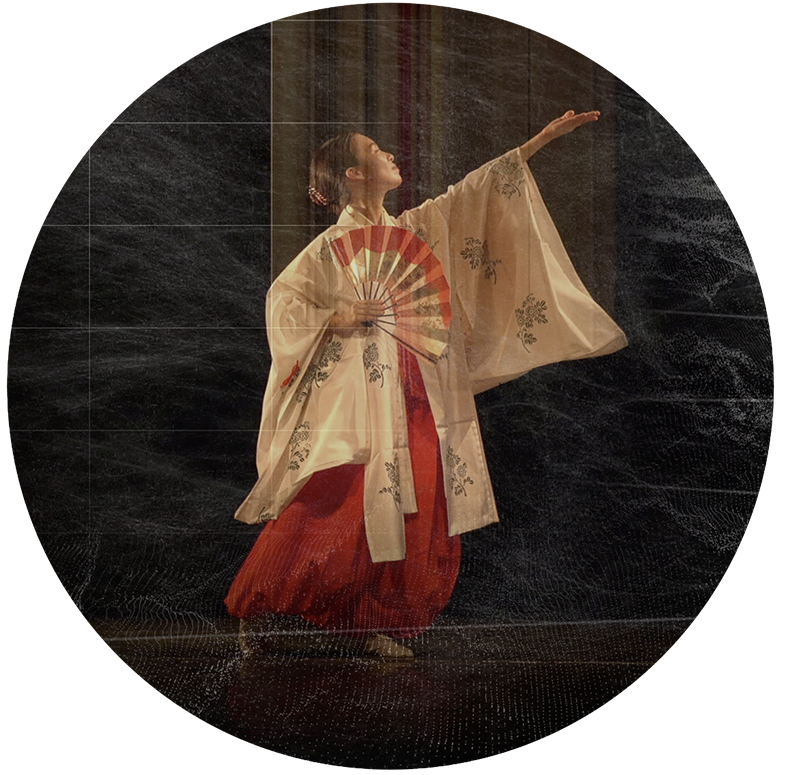
HORSES 馬
In the Asian zodiac, 2026 heralds the Fire Horse - a year of movement, new beginnings, alignment, freedom, beauty, passion, and flow. The majestic horse embodies vitality and transformation, carrying humanity forward through time. HORSES honours this spirit through a unique fusion of Asian and Pacific arts voices, championing physical prowess and grace while bridging ancient traditions with contemporary digital cinema.
Electronic-jazz pioneer Mark de Clive-Lowe's new score interweaves powerful taonga pūoro from Mahina-Ina Kingi-Kaui (Kāti Irakehu, Ngāi Tuahuriri Kāti Huirapa, Te Whanau Pokai. Kāti Māmoe, Kāi Tahu, Ngāti Porou, Te Āti Haunui-a-Pāpārangi) and Ariana Tikao (Kāi Tahu). Dynamic choreographic vignettes feature Tsukushi-mai dancer Nao Kamei, hip hop artists Ririka Takizawa, Joshua Faleatua, Tyler Carney-Faleatua and Karim Araoka, alongside returning performers Airu Matsuda and Chikako Arai.
World Premiere Lunar New Year Festival Te Papa Tongarewa Museum of New Zealand 2026 (Pōneke, Wellington)* Matariki Premiere 2026 Te Matatiki Toi Ora Programme Liveset Performances with Mark de Clive-Lowe (piano and electronics), Mahina Kingi-Kaui (taonga pūoro) and Daniel Belton (keyed film projection)* South American Premiere Digital and Cinema Programme International Image Festival 2026 Manizales and Bogotá*
Award Winner Best Music Video Swedish International Film Festival* Award Winner Best Music Video Indian Independent Film Festival* Award Winner Best Music Video South Asian Indie Film Festival* Award Winner Best Dance Short Film South Asian Indie Film Festival* Award Winner Best Original Score South Asian Indie Film Festival* Award Winner Best Producer Short Film South Asian Indie Film Festival* Award Winner Best Editor Short Film South Asian Indie Film Festival* Award Winner Best Director Short Film South Asian Indie Film Festival* Award Winner Best Experimental Shorts Black Panther International Short Film Festival Delhi* Award Winner Best Music Video Black Panther International Short Film Festival Delhi* Award Winner Best Music Video Kyoto Cinematica Film Festival* Award Winner Best Experimental Music Video Festival De Indie Chennai* Award Winner Best Music Video Chalachitra International Film Awards Italy*
Award Nominee MOONDUST Helsinki Film Awards (Best Music Video)* Award Nominee Swedish International Film Festival (Best Dance Film)* Award Nominee CREATOR X AWARDS (Best Music Video)* Semi-Finalist Pražské filmové ceny IndieMania Prague Film Awards (Best Music Video)* Semi-Finalist FILMONACO (Best Music Video)* Semi-Finalist ICEBERG Film Awards Oslo (Best Music Video)* Semi-Finalist FARO Concurso de Cinema Mediterrâneo e Mundial (Melhor Vídeo Musical)* Semi-Finalist Caçador de Filmes Mexico (Best Dance Film)* Finalist Humro Cinema Film Festival Pokhra (Best Music Video)* Semi-Finalist Film Revolution Montréal (Best Music Video)* Semi-Finalist FilmHaus Berlin (Best Dance Short)* Semi-Finalist Planet-Cinema (Best Music Video)* Semi-Finalist Nocturna Brooklyn Film Festival New York (Best Music Video)* Semi-Finalist DARKLAND Munich (Best Music Video)* Semi-Finalist YETI FILMFEST (Best Music Video)* Finalist Global Visionaries Film Festival Singapore (Best Music Video)*
Director Notes
"Horses completes our trilogy exploration of Ma - the Japanese concept of productive emptiness, where void becomes choreographically active. Nao Kamei carries this philosophy through her 1200-year-old Tsukushi-mai dance tradition, connecting us to the supernatural, to the animal kingdom, to nature and mother earth.
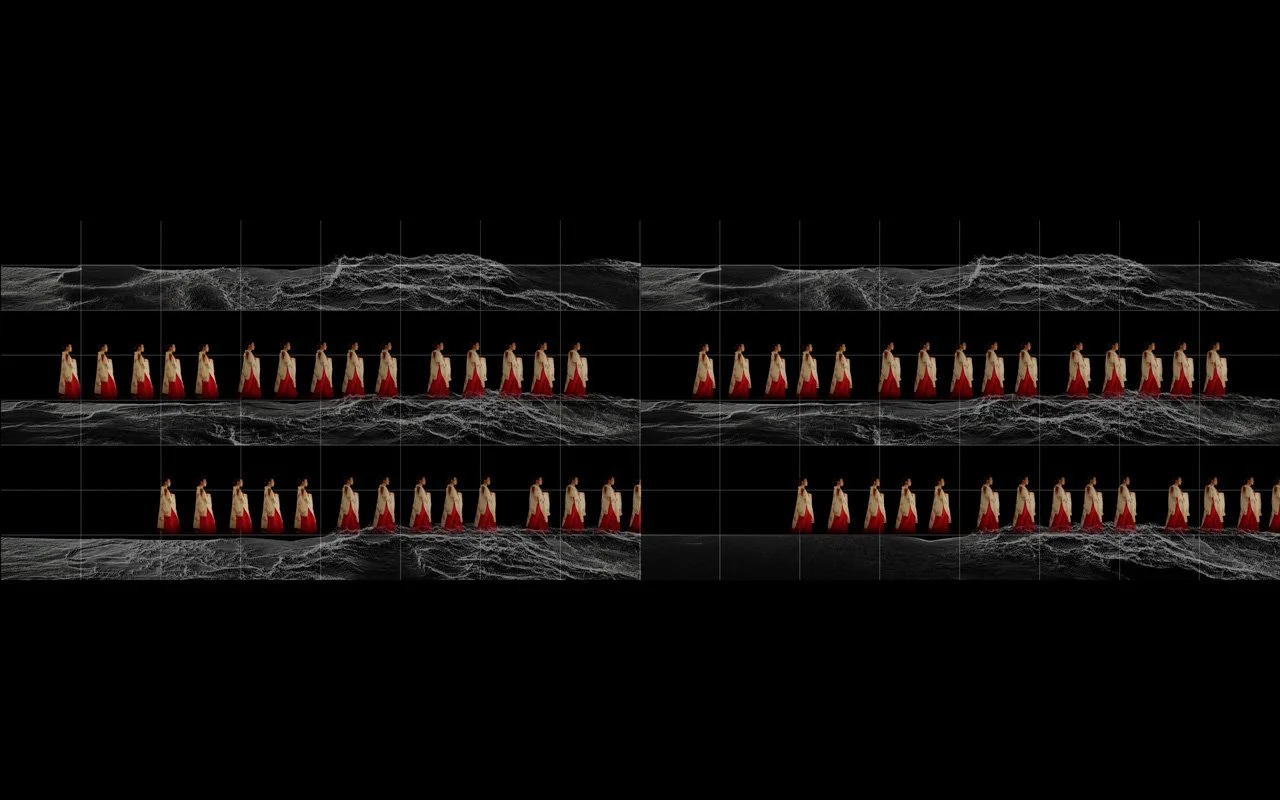
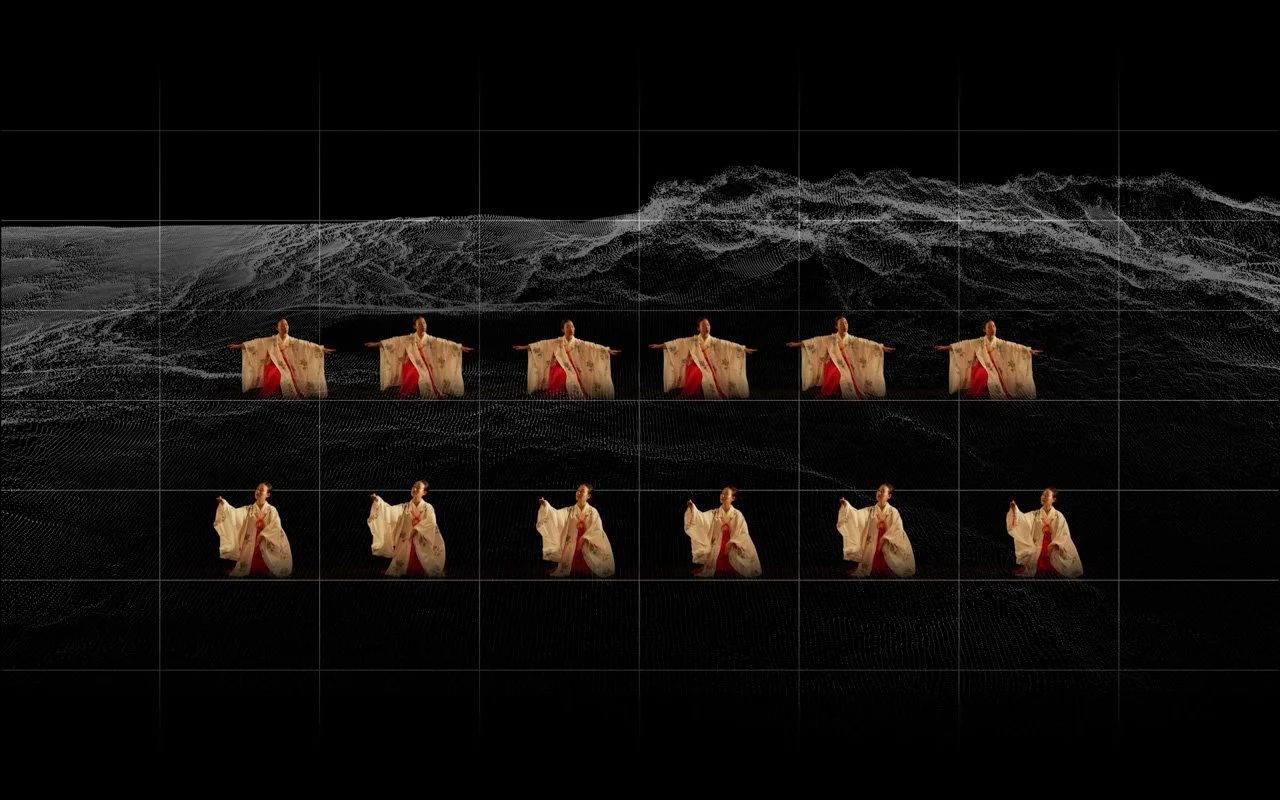
In the opening scene, we observe Kamei conjuring the cinematic elements - summoning atmospherics, calling forth Jac Grenfell’s suminagashi ink topographies that roll out as rhythmic vistas. She appears as a cosmic deity who gestures, pulses, spins, conducts - masterfully sculpting time and space to call in the urban dance figures - our jubilant hip hop team alongside Airu Matsuda (Tiger & Dragon) and Chikako Arai (Dragon).
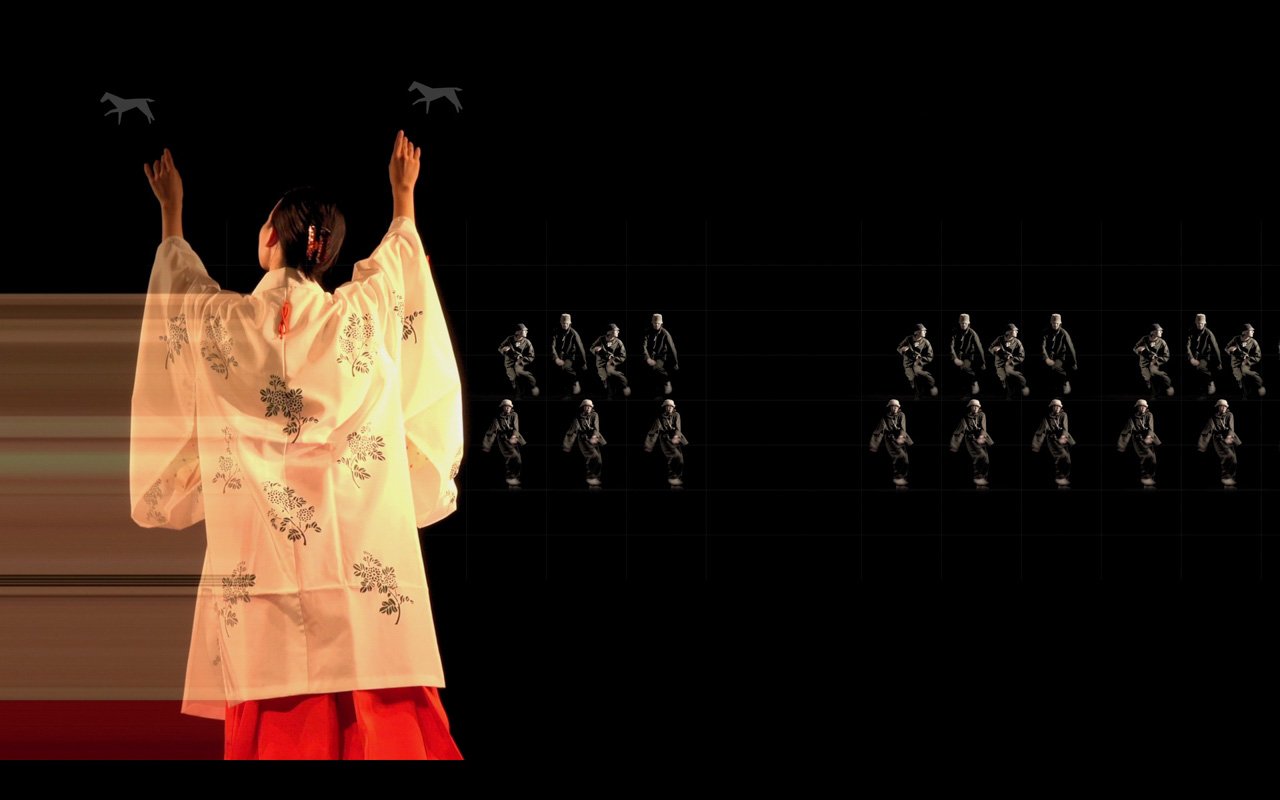
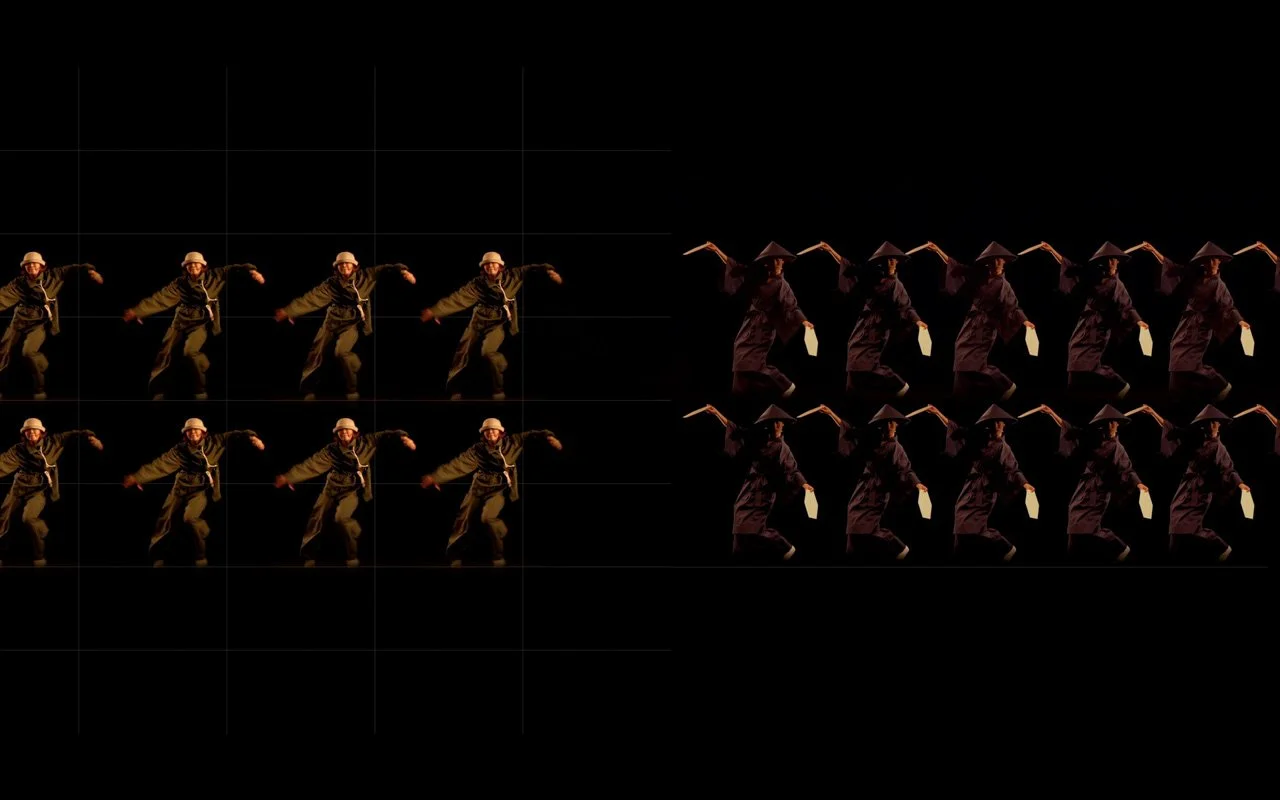
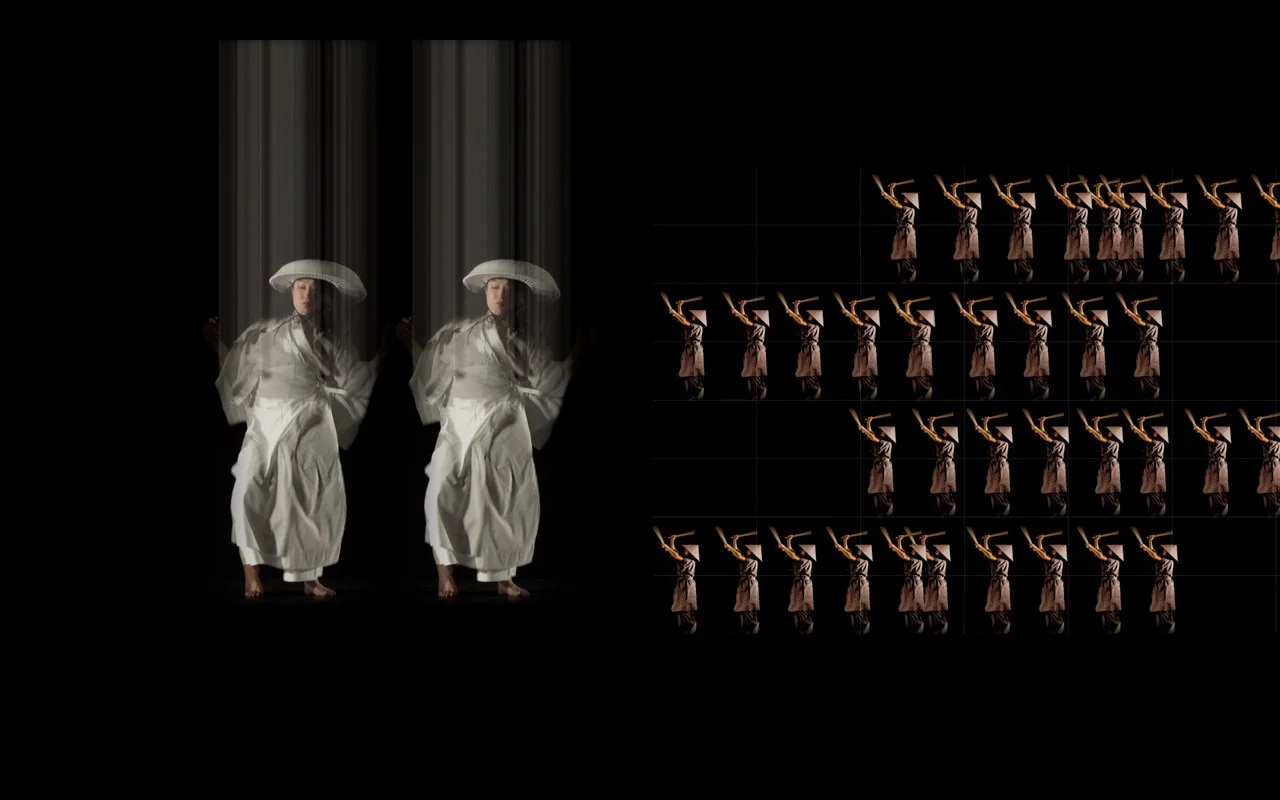
The film is structured through mado panel grids - traditional Japanese window patterns (mado 窓 derives from me no to 目の戸, meaning ‘eye's door’) that echo both the abacus and cinema's film-strip origins. These gliding frames anchor the dancers spatially while transmitting multi-layered figures that ripple across the screen in sync with de Clive-Lowe's sensational music. At times, I remove the mado grids completely, allowing the dance figures to float in the void as if their movement sustains their elevation. The film scaffolding contains yet liberates, creating multiple viewpoints dancing simultaneously.
This approach is inspired by Akira Kurosawa's Dreams - specifically the Peach Orchard scene, where he uses a choreography of figures moving across terraced slopes. It is mathematical, poetic - his widescreen composition creates a pattern of multi-layered tiers. As Kurosawa himself said: 'There is something that might be called cinematic beauty. It can only be expressed in a film, and it must be present for that film to be a moving work.' This is what we pursue in Horses - that quality of cinematic beauty achieved through digital terracing of figures across the frame.
Throughout the work, PJ Illustration's hand-animated horse - paper-cut and origami-like - reappears playfully, harking back to Étienne-Jules Marey's revolutionary chronophotography studies. Marey and Muybridge visualised the invisible force-lines connecting movement across time and space. Horses acknowledges this legacy while framing our futuristic narrative through cinema's origins.
The balance between Kamei's ancient tradition and Mark's electronic jazz, infused with the taonga pūoro, speaks to cultural continuity and transformation. In the final scene, a herd of horses gallops while Kamei-san casts and fans her trailing silk fabric as both encouragement and beckoning to the Fire Horse year, ushering in movement, alignment, freedom.
Kurosawa also taught us: 'A film must be made with the heart, not the mind.' Physical dance becomes manipulable digital data, transforming 3D performance into 2D cinematic possibilities that extend beyond live performance limitations. This is the gift of choreographing media - where 'emptiness is form, form is emptiness' and the void breathes with technological mediation.
Horses celebrates the qualities this zodiac year brings: movement, new beginnings, alignment, freedom, beauty, passion, flow. Creative Producer Donnine Harrison and I thank the brilliant artists who have brought their exceptional creativity to this trilogy vision."
Daniel Belton (February 2026)
Creative Partnerships
Working with Nao Kamei has been a privilege. Her mastery of Tsukushi-mai - a 1200-year-old dance tradition - carries centuries of knowledge, ritual, and spiritual practice. When Kamei-san gave her consent for us to combine this ancient form with the contemporary buoyancy of urban street dance, she opened a doorway few artists might risk. These forms may seem incompatible - the sacred slowness and precision of classical Japanese dance alongside the explosive, improvisational energy of street culture. Yet within the matrix of film, the potency of both worlds can co-exist. They speak choreographically to each other in the digital space-time of HORSES, creating dialogue across centuries, across cultures, across movement vocabularies. This fusion would not have been possible without Nao Kamei's trust, her openness, and her understanding that tradition lives through transformation.
The trilogy honours ongoing commitment from artists who appear across multiple films. Airu Matsuda danced solo in TIGER - the first film where we were discovering the new language for what would become a six-year journey celebrating the venerable Asian zodiac system. For DRAGON, Airu embodies the orange-red Fire element, and it follows that he must return in HORSES - carrying the flame of Tiger energy into the Fire Horse year, supporting and uplifting this zodiac convergence. For audiences following the series, this creates a clear trajectory and continuity.
Chikako Arai (IDIOT SAVANT Theater Company - Tokyo) featured prominently in DRAGON as the Air element - appearing in white, holding a disc moon and hexagons. The geometry of the hexagon flows from DRAGON through to HORSES, where in a spectacular scene Nao Kamei catches a hexagon object mid-flight while wearing her samue worker's garb. Kamei actually performs two distinct roles in HORSES: the Shinto deity figure of her Tsukushi-mai lineage, and a blue-costumed drummer and spatial activator wielding handheld hexagons - as if following instructions from the deity figure herself. Chikako radiates the essence of Amaterasu (Sun Goddess) in DRAGON, and her return to HORSES feels essential - coming full circle in the trilogy's arc. She dances with intense pulse and authority wearing her large wide-brimmed white sun hat and full white kimono-style costume. Both Chikako and Nao Kamei's Shinto deity figure receive the same VFX effects - tracings and emanations that evoke the supernatural otherworld - higher dimensions of the spirit world.
HORSES canters, gallops and surges, creating a cosmic mosaic of dance and music. As we reflect on why this fusion works Daniel says "Dance and music function omni-spatially because they operate across all registers simultaneously - physical, emotional, temporal, spatial, cultural. They do not require translation yet they translate everything." Mark's scores embody this principle - they are the bridge that allows Tsukushi-mai, dance-theatre and contemporary hip hop to speak the same language, a connective sonic tapestry that holds our trilogy together.
Daniel, Donnine and the Good Company Arts team are very grateful to Mark de Clive-Lowe for his collaboration across this trilogy. The incredible scores he has created for these films have inspired impassioned performances from our dance artists and within the post production process. For each film, we had Mark's music in development to respond to as we workshopped and captured dance-theatre action. His compositions became active partners in the creation process, shaping how dancers moved, how energy flowed through space. The film trilogy represents Mark’s first collaboration with taonga pūoro artists, and it has been wonderful to witness this powerful fusion unfold across the films - to hear and feel the sonic frequencies of ngā taonga pūoro raising the wairua of our co-creation through the music scores, the dance and the film. Kā mihi nui Mahina, Ariana and Alistair Fraser for your stunning contributions.
HORSES signals our third collaboration with Mark, completing the Asia-Pacific trilogy that began with TIGER and continued through DRAGON. The poignancy of this partnership heightens when we consider his Japanese and New Zealand heritage. Mark’s electronic jazz compositions carry this dual cultural lineage, linking the worlds our trilogy explores. His music pulses with ancient resonance and futuristic vision, generating the aural blueprints for our dance and cinematic responses.
Mark de Clive-Lowe "My role across the Asia-Pacific trilogy has been to create music that could exist in dialogue with movement rather than sit beneath it. For Horses, this meant allowing the score to unfold patiently - moving from ambient space into rhythm as energy gathered - with piano improvisation acting as connective tissue throughout.
The taonga pūoro performed by Mahina-Ina Kingi-Kaui and Ariana Tikao brought an essential grounding to the work, holding a sense of breath, land and lineage that shaped how the electronic and jazz elements could move. Working with Daniel Belton and Good Company Arts over the course of this trilogy has been a rare and meaningful collaboration, where music became a living architecture for dance, cinema and cultural exchange. Horses completes this journey with a sense of flow, continuity, and shared presence"
Daniel and Donnine's creative partnership across thirty five years, began as students in 1988 when they danced together, later working in the UK and Europe before returning to Aotearoa to co-choreograph and perform in GCA's formative works. For HORSES and across the Asia-Pacific trilogy, Donnine has been involved in design decisions influencing costume and couture, present in all film shoots and choreographic labs, running cameras when needed, and providing the logistical planning that enables these multi-cultural collaborations to develop. This trilogy, and all GCA projects, carry her creative fingerprints.
Vision
HORSES concludes Good Company Arts' Asia-Pacific trilogy by exploring how we perceive time and how cultural knowledge flows across generations. The film draws from three interconnected wellsprings: Étienne-Jules Marey's pioneering chronophotography, Japanese spatial philosophy, and the 2026 Fire Horse zodiac year.
Traditional Japanese grid window patterns become dynamic film-strip portals in HORSES. These create multiple temporal viewpoints of dance unfolding, visual syncopation matching the music's pulse, and a bridge between ancient Japanese scroll painting traditions and modern celluloid. The grid is simultaneously abacus, architectural framework, and cinematic device.
Good Company Arts extends gratitude to Linda Lim, Lunar New Year Festival (Te Whanganui-a-Tara, Wellington), and Te Papa Tongarewa Museum of New Zealand for hosting our Asia-Pacific trilogy as we collectively enter the Year of the Horse. Ngā mihi maioha Tānemahuta Gray, brother in dance, for your karakia timatanga. Ngā mihi nui Creative New Zealand toi Aotearoa for the pūtea tautoko that fuels this trilogy.
"…a living, breathing structure of sensation" SIFF
Swedish International Film Festival Review: https://thesiff.com/review-horses/
"As a music video, HORSES succeeds in allowing sound and image to evolve together. Mark de Clive-Lowe's score forms a compelling emotional foundation, while the inclusion of taonga pūoro performed by Mahina-Ina Kingi-Kaui and Ariana Tikao adds a distinctive cultural texture that deepens the audiovisual experience. Rather than functioning as accompaniment, the music actively shapes the pacing and emotional progression of the visuals, reinforcing the film's immersive quality. The performances further elevate the work through precise physical expression and disciplined choreography.
HORSES demonstrates a confident understanding of the music video as an expressive cinematic form, where choreography, sound, and visual design function as equal narrative forces. Through its sophisticated aesthetic vision, inventive multimedia integration, and emotionally driven visual language, the film establishes a memorable artistic identity and stands as a compelling example of contemporary experimental music video filmmaking” Chalachitra International Film Awards







"Dance and music function omni-spatially because they operate across all registers simultaneously - physical, emotional, temporal, spatial, cultural. They do not require translation yet they translate everything" Daniel Belton 2025